If you have exposed yourself to Korean cuisine, you might have a specific idea of what Tteok is. That chewy stick made out of rice which is the main ingredient of Tteokboki. Sometimes they are disc-shaped like the ones in Tteok-guk that we eat for Lunar new year. Or maybe you think about the mochi type of tteok, filled with some sorts of sweet beans inside. They are tteok, aren’t they?
They are. But also Tteok is so much more than them. Tteok is not a specific dish. It is more like a collective noun of… a state of the food. If something gets mushed and clumped together, it is tteok. Have you ever abused your erasers to make a bunch of debris from it to recollect them to make another gross eraser when you were young? We called it eraser-tteok. Here is another example. I never acquired a taste for it, but some kids loved smashing their choco-pie in its plastic package and making a big clump out of it. That was choco-tteok. (well, it was called ddong more often actually, which means poop.) Tteok-chida literally means making tteok by slamming steamed grains, but it is also a slang for having sex, just like how you get mushed and clumped with an intimate act.
But the problem is, Tteok somehow got translated into ‘rice cake’ in English. There is one big problem that how the hell tteok got the same name with a hard rice puff disc, but then there’s this other problem that there is tteok made out of not-rice. One that I always look for is the wheat one. Wheat rice cake, (mil-tteok, 밀떡), is one of dominant tteok for tteokbokki in Korea. It is assumed that Koreans started making mil-tteok after the Korean war, out of scarcity of rice. Tteok made out of wheat tend to stay better in long, residual heat, but also it has its own bounciness that rice cake doesn’t have. Rice tteok tends to cling to your teeth, giving you a satisfying chew. On the other hand, wheat tteok gives you a playful bounce in your mouth. Some tteokbokki stores have two separate griddles, one for wheat one, the other for rice one. They ask which one I want when I order. I like wheat one better, but my mom likes it half and half.
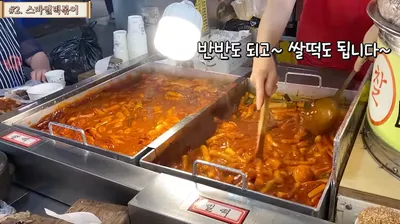
Left griddle is labeled as ssal-tteok (rice cake), The right one is labeled as mil-tteok(wheat cake). Screenshot from Youtube 연동이네 channel
I realized this problem when I started shopping for Korean groceries online. I love physically being in a Korean grocery store. It gives me my k-life. Let me touch all of the golden crunchy melons, which survived a long journey from my mother country. Let me hold my urge to k-splain all the differences between gochujang brands to people who are so lost in front of all the options. But alas, Covid happened so it became inevitable that I would turn to online shopping at some point. When I was filling my online cart, I got so stumped in front of the search engine bar. What should I type for my mil-tteok. wheat rice cake? rice wheat cake? wheat cake?
When I finally got my hands on mil-tteok. I checked the package to see how it was named in English, and it was labeled as ‘wheat cake.’ If ‘rice cake’ was named for its ‘savory cake-ness’, it is probably an appropriate English name, but for ‘wheat cake’ it is a bit tough to compete with the entire tradition of cakes baked with wheat flour. I feel the awkward destiny of tteok trying to fit itself in English, and losing its context in the process. Tteok is living its immigrant’s life. We will stand smothered in gochugaru together amongst the beautifully decorated birthday cakes.