I have a pet peeve. I can’t stand people eating Bibimbap with chopsticks. It is not about table manners. Yes, it is a Korean table-side manner to eat rice and soup with your spoon, and banchans with chopsticks. But even I eat rice with chopsticks when I can’t be bothered to change utensils. But this is Bibimbap. You just put all your effort into bibim-ing (mixing) things, so you could taste all those ingredients dancing harmoniously in your mouth. It makes me sad that you would then eat only a few grains of rice and a single bean sprout per bite with your chopsticks.
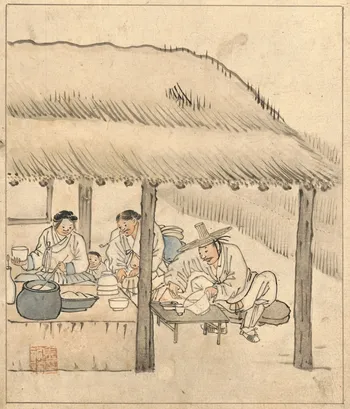
This is how I want everybody to eat Bibimbap.
When I caught one of my coworkers using a pair of chopsticks for his take-out bibimbap from a Korean deli, I asked him why. At least from the answer I got, it was not something thought out. It seemed like it was a combination of the American way of eating, where people don’t use a spoon unless it’s for liquid, and the stereotype of the East Asian way of eating, which always involves using chopsticks for food. That might be true for dishes from countries that actively use chopsticks except… Korea. Tableside manners of other countries in the ‘chopstick sphere’ (Wang, 2015) ask people to use chopsticks for bap, and hold the bowls close to your mouth so the grains don’t get spilled. Korean manners ask you to leave the bowl alone, using the spoon to scoop the grains out of it. How did Korea end up with this exception?
I am surely not the first Korean with this question. Park Ji-Won, a scholar from the Joseon dynasty, was the writer of Yeolha ilgi (熱河日記, Jehol Diary). In 1780, he traveled to Rehe in China to celebrate the birthday of the Qianlong Emperor of the Qing Dynasty. On this journey, he faced challenges eating rice with a Chinese spoon that had a deep, flat bowl. He cracked up the scholars from Qing by saying that you would need a beak like a bird to eat out of the spoon. Despite the fact that he could only communicate only through writing Chinese characters (elites from the Joseon era all had to know Chinese characters very well, but still, wow), Park Ji-won kept asking how Qing people could eat rice with such an inconvenient spoon. All the while, Qing scholars kept laughing and said they no longer use a spoon even for bap anyway.
The scholars from the Qing dynasty acted clueless, but spoons were in fact widely used in China, even more than chopsticks until the 12th century. The staples in China until that time were millet and the porridge made from it. These are types of food that require spoons. However, around the 12th century, things started changing as winter wheat farming began in the north of the Yanzi river. New crops led to new dishes based on wheat, such as pancakes, noodles, and dumplings: all the good things that require less use of a spoon. Noodles were so good that people who had to move south of China started making noodles out of rice, which would have helped the spread of chopstick use even in the region where wheat was not grown. Meanwhile, the chair was introduced into Chinese culture which led to sharing food on the table and dishes such as hotpot. Chopsticks gained more and more advantages as they would minimize contamination with saliva on the shared dish (Wang, 2015). This contrasts to the eating habits of the Korean Peninsula, where people sat down to eat at individual small tables until the end of the Joseon Dynasty.
Chopsticks spread to other countries such as Japan, Korea and Vietnam. Except for Korea, each country adopted chopsticks as a dominant utensil for a respective reason. Vietnam shares the border with southern China, and also was governed by China until the 10th century. Compared to other countries in South-east Asia that used hands for eating, Vietnam adopted chopsticks as a main utensil with the influence of China. Japan on the other hand, though geographically isolated from China, still actively sent people to China to learn if there were any good things there. Chopsticks came to the Japanese archipelago, however, spoons were never widely used in its history. No spoons were discovered in Japanese settlements, in contrast to Korea where spoons were the main utensils found in archaeological excavations up to the late Joseon era. Some scholars say it is because Japan had a kind of glutinous rice with good stickiness that was easy to handle with chopsticks (or hands) from as early as AD 300. Vietnam consumed a different kind of rice, yet it also adopted chopsticks as its primary utensil. This makes me wonder if the fact that people already used spoons before adopting chopsticks plays a role there.
There were not many areas suitable for wheat harvest in the Korean peninsula, with only a small part of the north-western region being suitable. Bab, soup, and banchans have been the core of a Korean meal even to this day. On top of that, people used ceramics and metal bowls made out of copper and tin in the Korean peninsula. Have you ever been served a stainless steel rice bowl in a Korean restaurant? It is hot as fuck that you literally need hands of steel even to touch it. The thicker walls of copper and ceramic bowls wouldn’t get as hot, but they’d still be too hot to hold. Plus, they are heavy.
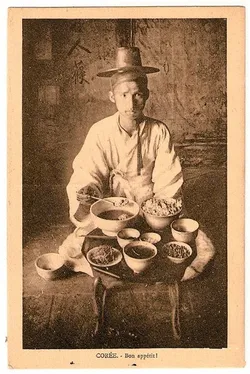
Everybody hates carbs now, so things have changed, but people in Joseon were famous for being big eaters. There are records of people from other countries being marveled by how much Joseon people could eat1. They would have needed a big bowl to eat a lot, and a spoon to scoop the food out of it. Some scholars point out that Joseon was built based on Confucianism, following Confucius’ disciplines established from the Zhu dynasty, before the 12th century. It is probably a combination of all of this as to why Koreans are an exception to the chopstick sphere, actively using chopsticks but only as a secondary utensil. But I, a Korean who watches mukbang and wonders about the prevalence of big eaters in such a small country, am personally more interested in the big bowl theory.
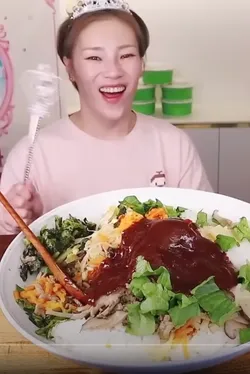
I was once asked what utensil I would choose for eating if that were the only utensil I could use for the rest of my life. Without thinking much, I said I would choose the spoon. My answer was not very popular, and every counterpoint brought up in the conversation made so much sense. Most of the time, chopsticks can replace the job of spoons, and I can drink the liquid directly out of the bowl. But what I can’t give up is the experience of collaging all the flavors and textures on my spoon. A little bit of bap that gets soaked into the spoonful of jjigae, sauce that is just enough to submerge dduk and fish cake from ddukbokee, all the ingredients along with rice from bibimbap: all these things happen on a spoon. The thought of never being able to assemble little bites on my spoon for the rest of my life makes me sad.
About a decade ago, I watched a video of a person giving a tour of LA K-town. I recall the person sharing a hot tip on how to enjoy tofu soup: by soaking the rice in some of the soup with a spoon. I remember this vividly because I always thought this was somewhat human nature: dipping rice into soup, up to that point. The fact that some people have to be told to do so was just news to me. Being aware that it is such a gift that was given to me with the spoon culture, I load up rice and soup on a spoon today, as always.
References
- Joo, Y. (2018). Why do Koreans eat like this?: A history of Korean food culture through dining practices. Humanist.
- KBS. (2021, December 7). Korean spoon culture that was different from China and Japan [Video]. YouTube. https://www.youtube.com/watch?v=poe8wwcX4nI
- Kim, J. (2020, May). Wheat and barley, more familiar and more delicious. Green Magazine, 177. Rural Development Administration. https://www.rda.go.kr/webzine/2020/05/sub1-2.html
- Kwon, S., Park, Y., & Choi, J. (2017, January 23). [SBS Story] Joseon, the land of food fighters. SBS Story. https://blog.naver.com/subusunews/220918016350
- Park, J. (1780). Hogjeongnildam (Miscellaneous notes from Jehol). In Yeolhailgi (Jehol diary) (G. W. Lee, Trans.). Institute for the Translation of Korean Classics. https://db.itkc.or.kr/dir/item?itemId=BT#/dir/node?dataId=ITKC_BT_1370A_0120_000_0010
- Wang, Q. E. (2015). Chopsticks: A Cultural and Culinary History. Cambridge University Press.
- 입짧은햇님. (2025, August 18). 생일 기념 최애 편의점 음식 잔치~!! 비빔밥 10개와 신상 라면! 250818/Mukbang, eating show. YouTube. https://www.youtube.com/watch?v=EjHGx95lOKc
Footnotes
-
This is actually my favorite sub-genre of Korean history. To quote some of the observations from Westerners at that time: “A 65-year-old elderly man said he had no appetite and had five bowls of rice” (Mari Dablue, priest, 19c). “It only takes 3-4 people to eat 25 peaches and melons on one sitting” (Isabelle bishop, traveler), “The reason that Josun people don’t talk during the meal time is to eat more” (William Greenpeace, East Historia) (SBS Story, 2017) . But it is worth noting that it could have been a eating disorder in days when famine was routine. ↩